Leopard Conservation and Ecology Project (Leo-CEP)
Launched in 2014, Leo-CEP studies the ecology, population, and behaviour of the Sri Lankan leopard (Panthera pardus kotiya) across key national parks. Using modern tools like camera traps and capture-recapture models, the project provides vital data for conservation while fostering collaboration between the National University of Singapore (NUS), the Tropical Ecosystem Research Network (TERN), the Department of Wildlife Conservation (DWC), and the Sabaragamuwa University of Sri Lanka (SUSL). Co-PIs were Prof. Edward L. Webb (NUS) and Prof. E. P. Kudavidanage (SUSL/TERN). In 2024, a second phase began in Horton Plains to reassess leopard populations and habitat changes, supported by the For the Leopard Trust.
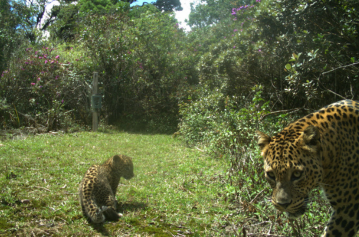
The Sri Lankan leopard (Panthera pardus kotiya) is the island’s apex predator and an endemic subspecies. Leopards are widely distributed across Sri Lanka, from the lowland dry zone to the misty montane forests, both within protected areas and in human-dominated landscapes. Rapid development, deforestation, and forest fragmentation are shrinking leopard habitats and forcing animals into close contact with people. This often results in conflict, including snaring, poisoning, and deliberate killings—tragically, many incidents have been recorded over the past decades, particularly in the montane areas. As habitats continue to fragment, leopards are increasingly driven to cross human settlements or prey on domestic animals, escalating risks for both people and wildlife. To conserve this endangered subspecies, it is vital to understand its population status, ecology, territorial use, prey selection, and the limiting factors that threaten its survival. Recognizing this, the Leopard Conservation and Ecology Project (Leo-CEP) was launched in 2014 with a survey of leopard ecology, population, and distribution in Horton Plains National Park (HPNP).
This initiative was a collaboration between the National University of Singapore (NUS), the Tropical Ecosystem Research Network (TERN), the Department of Wildlife Conservation (DWC), and the Sabaragamuwa University of Sri Lanka (SUSL). Co-PIs were Prof. Edward L. Webb (NUS) and Prof. E. P. Kudavidanage (SUSL/TERN). Combining traditional field methods with modern tools such as camera traps and capture-recapture models, the project achieved the first reliable population estimates of leopards in HPNP. Leo-CEP later expanded to Kumana National Park in 2017 and Lunugamwehera National Park (Yala Block VI) from 2018 to 2022. Across these sites, the project focused on:
• Identifying individual leopards and estimating populations
• Mapping activity zones
• Studying feeding ecology and behavioral patterns
• Strengthening collaborations between researchers and the Department of Wildlife Conservation
• Providing scientific evidence for leopard conservation
In 2024, a decade after the initial study, TERN revisited HPNP to reassess leopard populations and movements, taking into account significant habitat changes and the park’s growing reputation as a destination for leopard-watching. This second phase of research, supported by the For the Leopard Trust, seeks to provide new insights into leopard behavior and conservation needs in a rapidly changing landscape.